Travelling to a game alone is easy to plan and hard to enjoy, because the best parts happen in the three hours before kickoff and the hour after the final whistle. To meet other fans when traveling to a game, put yourself where supporters already gather: a supporter zone, a team bar, a fan club event, or the designated away section. Then open with one honest line about why you traveled. That is the whole method.
I have made this trip more than a few times, alone and with one other person, and the difference between a lonely seat and a great weekend is almost never the game itself. It is whether you showed up early enough to be standing somewhere people talk. Fans arrive in the same two or three places before every game, and they are strikingly friendly to someone who traveled to be there.
What follows is the practical version: what to bring, where to be, what to say, and when to leave. Updated for 2026, because venues keep changing their fan zones and the good tailgate lots get renamed.
Table of Contents
- What You Need
- How to Meet Other Fans When Traveling to a Game: Step by Step
- Common Mistakes and Quick Fixes
- Frequently Asked Questions
- How long should you arrive before the game if I want to meet fans?
- Is it safe to meet people at a game when I am traveling alone?
- I am shy. Is there a way to meet fans without small talk?
- How do I find fans of my team in a city where nobody supports them?
- How do you turn a one-conversation meeting into a real friendship?
- Start With One Easy Introduction
What You Need
You need very little, and most of it is not gear. It is timing and a plan.
- Your ticket, and a screenshot of it. Screenshots survive dead cell service, which is the normal state of a stadium concourse in the fourth quarter.
- Visible team colors. A cap or a jersey is enough. It removes the awkward introduction entirely, because other fans can see who you are from thirty feet away.
- A charged phone and a portable battery. If you plan to exchange contact details, you will not be able to search for anything else.
- A payment method that works in the venue. Some lots are cash only. Small bills help more than people expect.
- Your transport plan written down. Parking, the rideshare pickup zone, and where you meet your group afterward. Nobody has to hunt for you later.
- A flexible arrival window. Plan for three hours before kickoff if you actually want to meet people. The gathering zones thin out sharply in the final hour.
How to Meet Other Fans When Traveling to a Game: Step by Step
Research the Supporter Community Before You Go
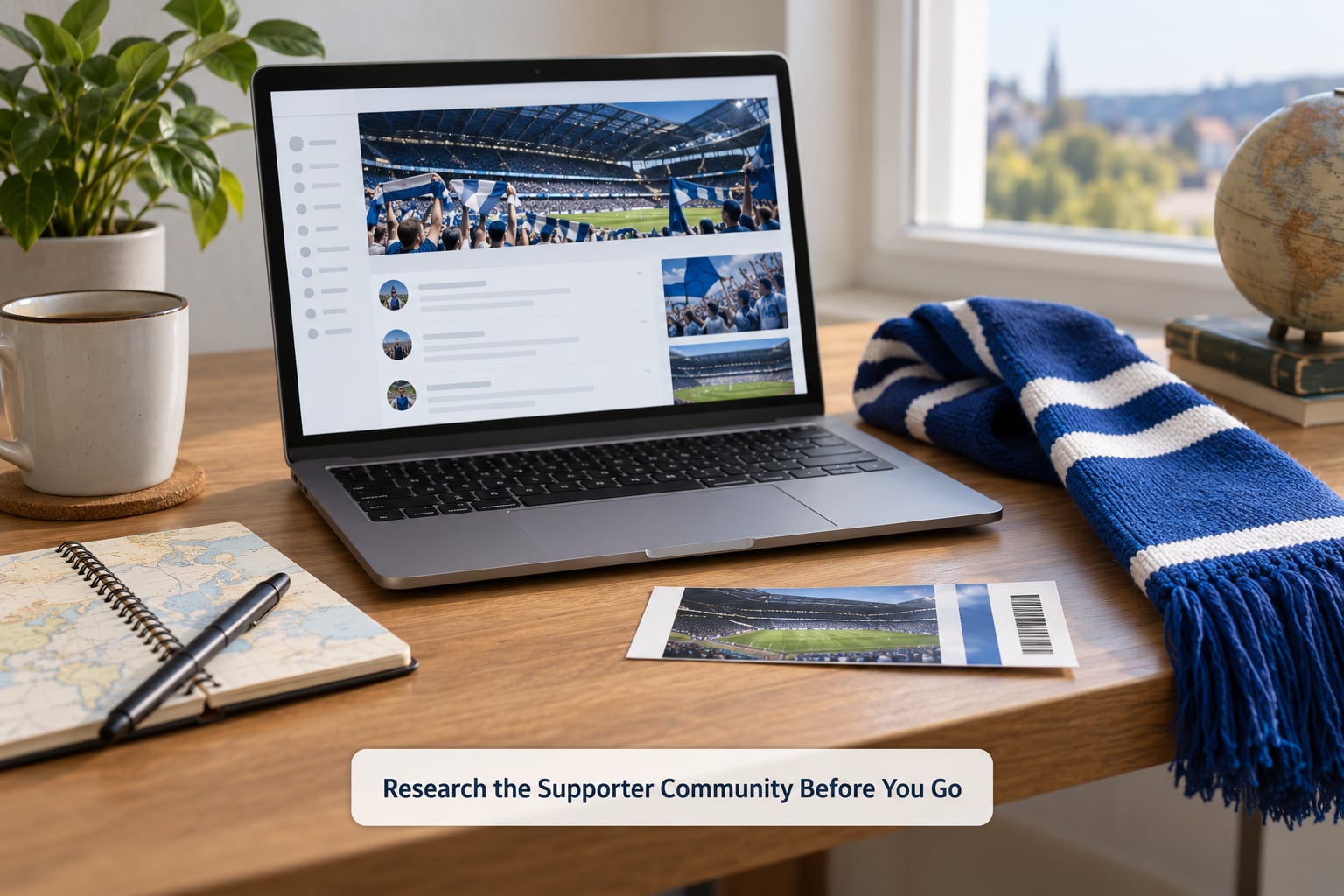
Start online. Search for a supporters group or fan club for your team in the host city, and check the team’s official site for a fan zone listing or an alumni event going on the same weekend.
Supporters groups are the organized fans of a club. They book ticket blocks, run the tailgates, pick a pub to meet at, and usually have a named traveling liaison who handles tickets and entry logistics for away matches. A veterans group in r/MLSAwayFans explained it plainly: away fans mostly find each other through these groups and their liaisons, and a casual fan can call the club’s ticket office directly and sometimes land away seats that way.
The team subreddit is the most-used channel by first-time visitors. Fans planning a first trip ask there for bar names, parking tips, and where to eat. An r/CFB advice thread for a specific away game gets hundreds of replies with local specifics nobody publishes officially. Post your question a week ahead and someone will answer it.
How do you tell a legitimate group from a sketchy one? Real supporters groups have an archive, a named contact, a history of events, and a fee structure that is explained up front. Anyone asking for payment through a stranger’s personal account on a social post is not a supporters group. The same goes for anyone promising guaranteed tickets in a section they cannot access.
Choose Seating and Tickets That Encourage Conversation
Where you sit changes how easy it is to talk to people. A supporter section is a block of season ticket holders who already know each other, so it is warmer but harder to enter socially. A lower-bowl section near the aisle gives you neighbors you will see all game and have something to say during a timeout.
Student sections and alumni sections are the loudest and the friendliest, if someone in your group can get you a ticket through the proper channel. Club seats and hospitality decks do the opposite. People are there with their own group and the room is working.
One rule covers all of it: never move into an area you do not have a ticket for. Away sections look inviting from the concourse and are controlled by the home club’s staff. Get in the way and you will not just be moved, you will be remembered.
Arrive Early at a Supporter Zone or Fan Event
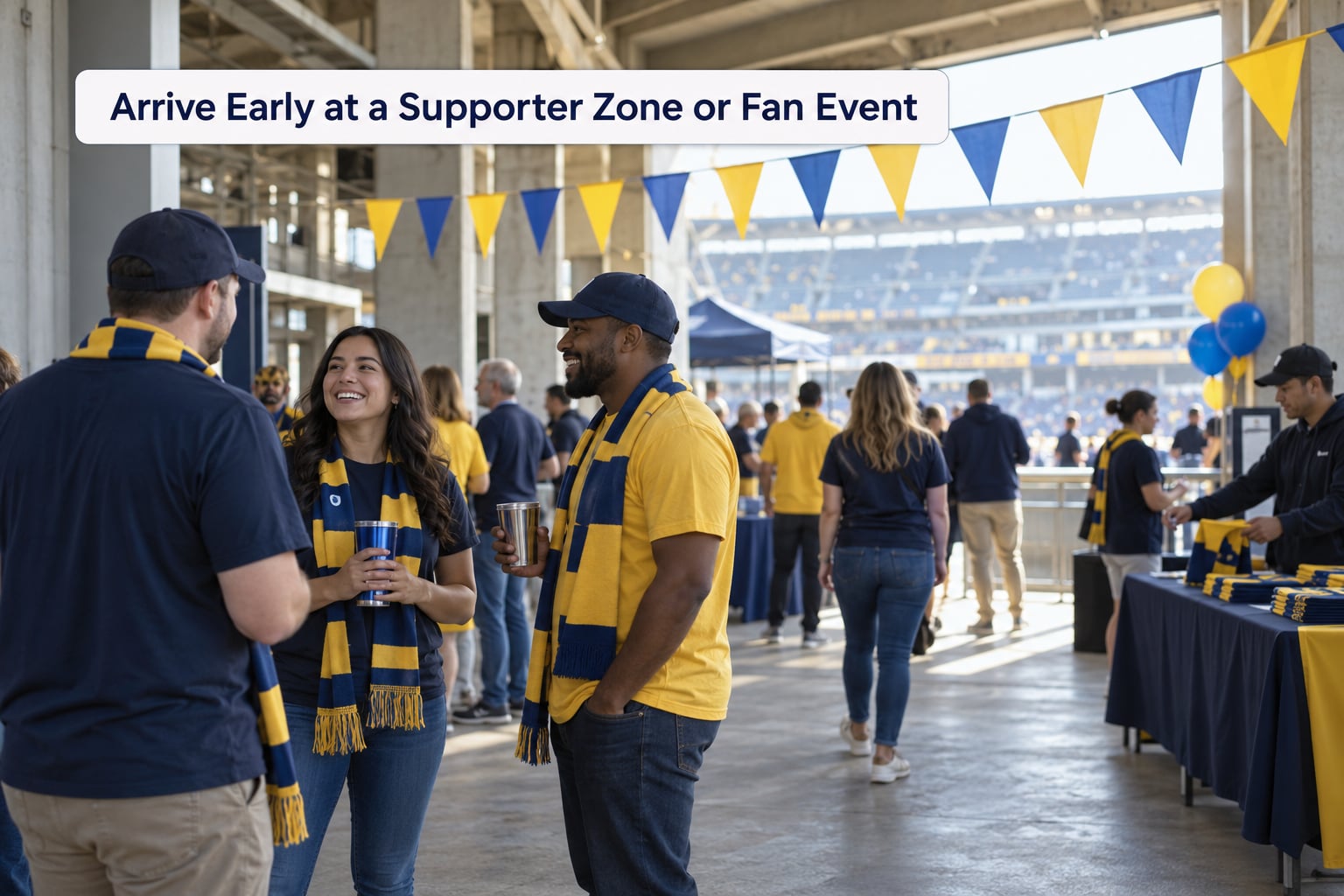
Getting to the right place early does more for you than any opener line. The tailgate lot, the fan zone, or the pub where the supporters group has gathered all fill in a predictable order, and the first hour is when the easiest introductions happen.
For a football tailgate, aim for three hours out. Bring something to share, even a bag of chips or a cooler of drinks, and set your chairs facing outward rather than inward. A base that looks open invites people over. A closed circle of six friends does not.
Walking into another group’s setup is fine if you read the room first. Wait for a gap in the conversation, stand at the edge, and open with something specific. “We drove down for this, first time here” is better than any joke, because it explains why you are talking to them at all.
Use Simple Conversation Starters
Game-day small talk is easier than it looks, because everyone shares at least three things: the team, the trip, and the current season. You do not need a good story. You need one of these lines:
- At a tailgate: “We came up for this one, first time at the stadium. Anyone else here from out of state?”
- At a team bar: “How long have you been coming in here? This is my first visit.”
- In the concourse: “That last drive was the whole game for me. What did you see that I missed?”
- Before kickoff: “Is this the loudest this place gets all season? We are trying to decide if we underestimated it.”
- After the game: “Where do you all go after this? We have nothing booked and we are starving.”
A fan who flew in from overseas once asked r/steelers how to handle a first game in Pittsburgh, and the answer he got back was exactly this: talk to anyone at any tailgate and say who you are and why you came. Being the outsider is the opener, not the problem.
Learn to read the response. Questions back, eye contact, a shift in the chairs to make room, someone kicking you a can, all of that means keep going. Short answers, a closed posture, someone putting on headphones, that means move on and nobody is offended. A brief “good luck today” and a step back is a perfectly complete interaction.
Connect During Breaks and After the Game
The best conversations in sports travel usually happen in the wrong place on purpose. A timeout at an aisle seat lasts three minutes and is long enough for two people to discover they went to the same high school. Halftime is where the real talking happens, because the seat is empty and nobody is watching the field.
Most venues also run a postgame ritual: the player statue, the trophy case, the team high-five line, the last-minute walk to the parking lot. Going to those places puts you in the same moving crowd as everyone else, which makes a second conversation feel natural rather than like another cold approach.
Shared transit is the easiest closer. If you are all going to the same neighborhood, say where you are headed and let someone mention the bar they go to. If you want their number, offer yours first. “Send me a photo of the stadium, I want to show my kid” is a request that is very hard to refuse, and it gives the conversation somewhere to go later.
Common Mistakes to Avoid
Five things ruin it for people, and all five are fixable.
The first is arriving at kickoff minus thirty minutes. The second is talking over the group instead of to it. The third is buying from anyone selling tickets in a lot or on a sidewalk; some of those are real season ticket holders reselling legally and some of them are not, and you cannot tell from fifty feet away. Buy from the club’s box office or its official resale partner only.
The fourth is oversharing. You do not need to give out your hotel name, your flight details, or where you parked your car to someone you met forty minutes ago. Sharing the general plan, the section you are sitting in, and the fact that you are traveling alone is plenty. Saying out loud that you are traveling alone, to a room full of people, is a good safety habit anyway.
The fifth is treating a friendly chat like a recruitment opportunity. Fans are unusually generous with their time on a game day. That works best when you are not asking anyone for tickets, seats, or a place to stay.
Common Mistakes and Quick Fixes
Here is the quick version, with a fix for each one.
- Showing up with no plan. Pick one gathering spot and one backup before you fly. Wandering between a lot, a bar, and a concourse means you meet nobody three times over.
- Overstaying a closed group. Watch for the moment people turn back to each other mid-sentence. “Good luck today, thanks for the chat” ends it cleanly and most people respect it.
- Wearing a full jersey and costume as a first move. Team colors are a friendly signal. A face paint kit is a conversation you have to win. Wear the hat, hold the jacket.
- Assuming everyone wants to be social. Half a stadium is focused on the people they came with. Treat every interaction as optional and you will never be the person who made it weird.
- Losing contact details to a dead phone. Exchange numbers before you enter the stadium, not in the fourth quarter. If the screen is dark, write it on the back of a ticket stub.
- Getting loud with home fans. Away fans are held to a stricter standard than home fans. Cheer for your team, applaud a good play by theirs, and skip the rest.
Etiquette for exchanging details is simple. Offer your number rather than asking for theirs, send the photo you promised within a day, and follow up with something from the game rather than a blank message. A single season ticket holder who likes you can hand you a whole community, so the follow-up is worth more than the conversation that started it.
Frequently Asked Questions
How long should you arrive before the game if I want to meet fans?
For football and hockey, aim for three hours before kickoff. That is when the lot is filling up but conversations are still easy, and it leaves room to be inside the building and settled before the anthem. Basketball and baseball games usually only need ninety minutes, because fans tend to arrive in one wave. Soccer supporters often gather earlier than that, at a pub near the ground. If meeting people is the point of the trip, later than ninety minutes is a mistake.
Is it safe to meet people at a game when I am traveling alone?
Game days are among the safer crowds to be in, because venues are staffed, families are everywhere, and rideshare pickups are centralized. Still, use the basics. Tell a friend where you are, keep your phone charged, sit in public areas, and say out loud that you are traveling solo. Pick a first meeting that is public and populated, such as a fan zone or a team bar, rather than a parking lot or someone’s home. Leave whenever you want. You never owe anyone a second drink.
I am shy. Is there a way to meet fans without small talk?
Yes, put yourself next to a group instead of in front of one. Standing at a bar rail beside a loud table or sitting a row above a family in the lower bowl works, because the game supplies the conversation for thirty seconds at a time. Shared logistics help too: asking about the best pregame food nearby, or whether the rest of the section is friendly, is a real question with a real answer. People who come to games alone are used to adopting quiet fans.
How do I find fans of my team in a city where nobody supports them?
Check the club’s official site for an away or neutral-site fan zone, then search for a local supporters group or fan club with the same search you would use at home. Team subreddits and fan forums usually have a thread for the specific match a few days out, and posters there are happy to point you at bars. If no organized group exists, the supporters bar near the stadium becomes the fallback, and showing up in your colors is usually enough to get included.
How do you turn a one-conversation meeting into a real friendship?
Be the person who follows up. Exchange numbers before the game and send something specific afterward, a photo of the scoreboard, a play you argued about, or a ticket stub. Mention that you are coming back for the rematch and ask if they want to sit together. Fans travel as a hobby, so a recurring game day gives you built-in reasons to see each other without the awkwardness of pure socializing. Most trip-based friendships start exactly this way.
Start With One Easy Introduction
Pick one legitimate fan community or supporter zone before you book anything. Find it online, show up three hours early in your team colors, and open with the simplest possible line: where you are from and why you came.
That is the whole trick. Nobody needs a plan to meet other fans when traveling to a game, only a place to stand and the willingness to say one honest sentence. The rest tends to sort itself out around the fourth quarter.