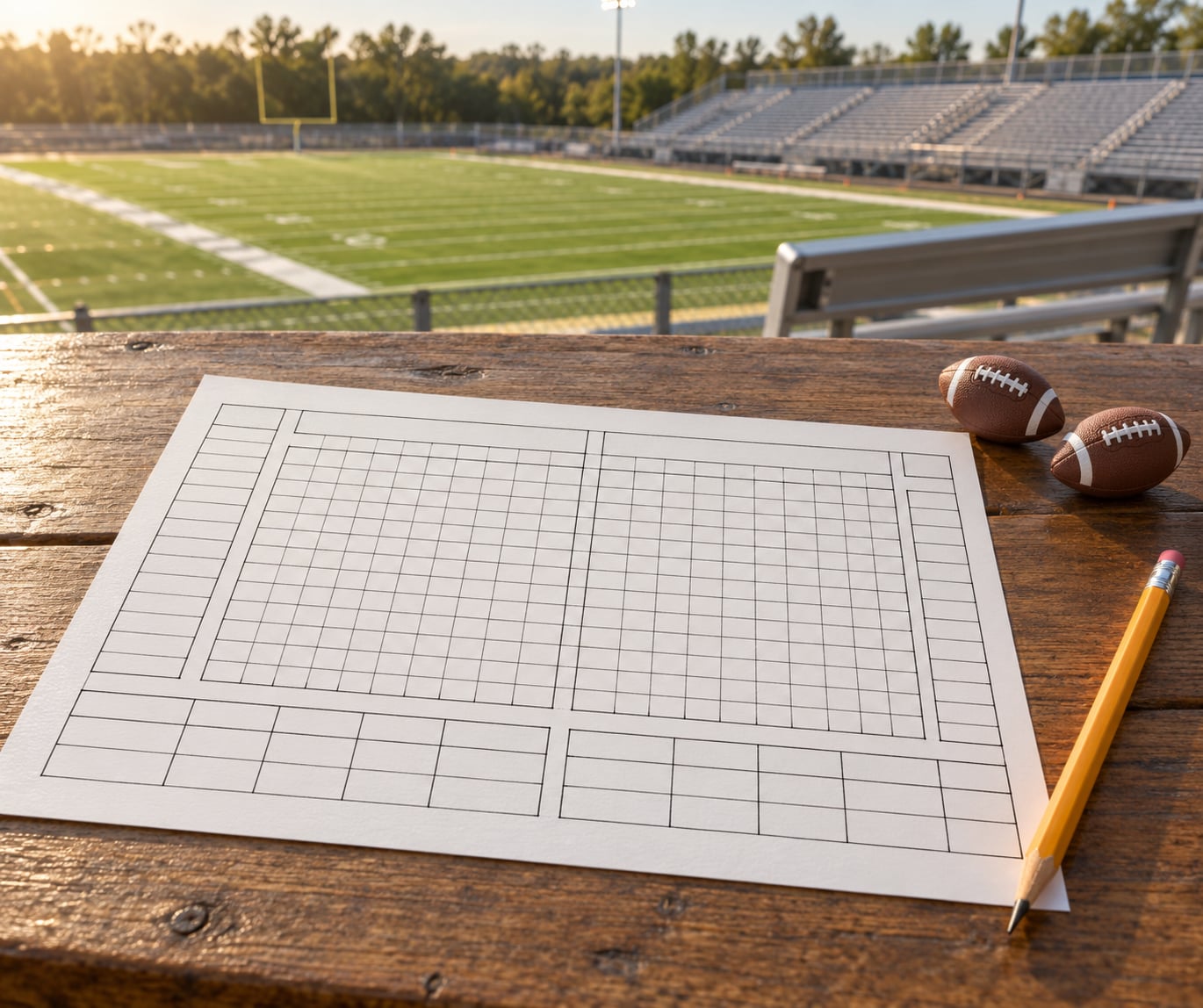
Keeping score at a football game by hand is simple once you split the page into a column per quarter. Write 6 the moment the ball crosses the plane of the goal line, then add 1 for the extra point kick or 2 for a two-point conversion on the kickoff that follows. Add 3 for a field goal and 2 for a safety.
It takes one quarter to find your rhythm. After that, most of your attention can go back to the game, and the score takes care of itself.
If you are new to American football, this is the fastest way to stop guessing. You will know exactly how many points every play is worth, when to write it down, and what to do when the number on the board jumps twice in a row.
Table of Contents
What You Need
Almost nothing. A pen and a piece of paper are enough, and any small notebook works if a full sheet is too big for your lap.
The one rule that matters: set up a column per quarter before kickoff. Add a column for overtime and a final total row at the bottom. Once you start writing numbers, you will not want to reorganize the page mid-game with 20 points on it.
Here is a layout you can copy onto any sheet of paper or notebook page:
Team: ______________          Home  |  Away

             Q1   Q2   Q3   Q4   OT   TOTAL
Home        ___  ___  ___  ___  ___   ___
Away        ___  ___  ___  ___  ___   ___

Drives:     Home 1. ___   Away 1. ___
Timeouts:   Home 3    Away 3
Down/Spot:  Home 1&__  ___   Away 1&__  ___
Write a running total in the far-right column. If you lose the thread mid-drive, that running total is usually enough to reconstruct the score.
Before the game, learn five numbers and you have everything: touchdown 6, extra point 1, two-point conversion 2, field goal 3, safety 2.
Step-by-Step: How to Keep Score at a Football Game by Hand

Scoring is the part that matters for the final number. Down-and-distance is the part that keeps you involved between scores. Work through both, in this order.
Step 1: Set Up a Simple Scorecard
Fill in both team names at the top before the opening kickoff, not during the first quarter. Leave the quarter columns blank and put a line under them for the total.
It helps to write the team abbreviations in large letters. Short names are readable at a glance in the stands, which is the only condition that matters.
Step 2: Record the Down and Spot
Down and distance are not points. They just keep you oriented and let you follow the drive.
Write the down as 1, 2, 3, or 4, then the distance needed for the next first down. When the spot moves, update the yard line number right after the play, not at the start of the next series. Waiting until the new series begins is how you end up one first-down marker behind the action.
A simple notation that works: 1 & 10 at AZ 30. One first down, ten yards to go, ball on the 30-yard line.
Step 3: Mark Big Plays and First Downs
Use tally marks in a separate column so big moments do not get lost in the number columns. Note a short gain, a first down, a long gain, a turnover, and a punt or kickoff.
The common categories are a first down, a big gain of 20 yards or more, a turnover, a defensive touchdown, and a punt or kickoff return. Write one mark per category so you can read back the shape of the game later.
First downs do not add points. They reset your down counter to one and move the line to gain, which is all they do.
Step 4: Add Points When a Team Scores
This is the whole scoring system in one table. Keep it next to your scorecard or memorize it and move on.
| Play | Points | When to write it |
|---|---|---|
| Touchdown | 6 | The instant the ball crosses the vertical plane of the goal line while an offensive player has possession |
| Extra point (PAT) | 1 | When the kick on the following kickoff passes between the uprights |
| Two-point conversion | 2 | When the run or pass from the 2-yard line crosses the plane |
| Field goal | 3 | When the placekick or dropkick clears the crossbar |
| Safety | 2 | When the ball carrier is downed in their own end zone; the two points go to the defense |
A touchdown can come from anywhere: a run, a pass, an interception return, a fumble return, a kickoff return, or a blocked punt. All of them are worth the same 6 points for the team that ends up in the end zone.
The extra point is a separate play. Write 6 for the touchdown, then write 1 or 2 for the conversion only when it happens.
Here is the mapping from the words you will hear to the number you write:
| Announcement you hear | What it means | What to write |
|---|---|---|
| Touchdown | Ball crossed the plane in the end zone | 6 |
| Extra point, good | PAT cleared the uprights | 1 |
| Two-point try, good | Conversion run or pass succeeded | 2 |
| Field goal is good | Kick cleared the crossbar | 3 |
| Safety | Ball carrier downed in their own end zone | 2 to the other team |
| Penalty, no good | Kick or try waved off | Nothing |
A worked example from a single drive. Team A starts the quarter tied 7-7. Running back breaks through for a touchdown: write 6, and the quarter column reads 13 for Team A. The extra point comes on the kickoff: write 1, and the quarter column reads 14. A conversion try instead of a kick would make it 8, and the quarter column would read 15.
Team B answers with a field goal in the same quarter. Team A’s column stays at 14, Team B’s column goes to 3, and the running total is 14-3 with the quarter still in progress.
Step 5: Reset the Ball Spot After a Score
After a scoring play, the ball resets rather than continuing from where the last play ended. Write the new down as 1 and the new spot as you would at the start of any series.
After a touchdown, extra point, or field goal, the kicking team touches the ball in its own end zone and kicks from behind its own goal line. The receiving team then takes over at its own 25. After a safety, the team that conceded it gets the ball at its own 1-yard line for a point of attack.
That reset is why a long touchdown return does not carry the next play forward. The spot always restarts after points.
Step 6: Track Timeouts, Penalties, and Quarter Changes
Optional details go in their own space at the bottom of the sheet, away from the score columns. Six timeouts per team in college football, three in the NFL, so check the league before you write the limit in.
Write a mark each time a flag is thrown only if you want to remember the drive context. You do not need penalties to keep score. You do need quarter changes, because the whole point of the column layout is knowing which quarter a score belongs to.
If a kick follows the end of a period, it belongs to the period in which the try occurred. Most scoreboards assign the extra point to the quarter the kick was attempted in, so put it there.
Step 7: Check Your Score at the End of Each Quarter
Pause once per quarter and compare your running total with the board or the on-screen graphic. A two-minute check at the quarter break is cheaper than rewriting the game after a late touchdown.
Correct mismatches immediately, then clear the down-and-distance line. Each new quarter starts with the ball at the 25-yard line and first-and-10 for the team that did not receive to start.
If the game reaches a tie at the end of regulation, write the tie as the final regulation total and start a fresh overtime column. Under current college and NFL rules, an overtime period begins with a coin toss, there is no kickoff, and the first team to score wins the game. Write those points in the OT column, never squeezed into the fourth quarter.
Common Mistakes and Quick Fixes
Losing track of possession. This is the most common problem. The fix is the down-and-spot line, and the fix for that is writing it the instant a series ends rather than at the start of the next one.
Counting a touchdown as 7 before the kick. Write 6 first, always. You can adjust the total to 7 or 8 after the try. Writing 7 up front means every missed kick leaves a wrong number on your sheet.
Forgetting a conversion attempt entirely. Some scorers never leave a space for it. Give the conversion its own line under the score so there is an obvious blank to fill.
Treating first downs as points. They reset your down counter and move the line to gain. Nothing is added to either team’s total.
Confusing the yard line with the line to gain. The current yard line is where the ball is. The line to gain is how far it must travel. They are two separate pieces of information, and mixing them up makes a drive impossible to follow.
Forgetting safeties. A safety is the least common score in football and the one most often left off the sheet. It is worth 2 points to the team that was not scored on.
Writing defensive or special teams touchdowns in the wrong column. They are ordinary 6-point plays, credited to whoever scored, and they belong in the quarter they happened.
Using one sheet for every level of football. The extra point is attempted from the 15-yard line in the NFL, the field goal distance is not the same in college, and some youth leagues skip the extra point entirely. Flag football commonly uses shorter fields and modified conversion rules. If you keep score for a youth or high school game, write that league’s numbers at the top of the sheet before kickoff.
One more practical habit: hold the sheet on your knee rather than the seat in front of you. The number of people who lose their running score by dropping a notebook between the seats is higher than you would think.
Frequently Asked Questions
Do I write down a touchdown as 6 or 7?
Write 6. The extra point is a separate kick that happens on the next kickoff, so you add 1 or 2 only when that try is complete. This is the mistake behind the most common new-fan confusion: a team at 24 reaches 30 on the touchdown, then the board reads 31 after the extra point. Write 6 first, and adjust the running total once the try is over.
Do I need to track the yard line and down to keep score?
No. If you only care about the final number, down and yard line are optional. They are worth writing, though, because they keep you following a drive between scoring plays and let you reconstruct the game if you lose the sheet. A good compromise is a single line under the score reading the down, the distance, and the spot.
How do I record a two-point conversion?
Add 2 to the scoring team in the quarter where the try happened. The conversion is run or passed from the 2-yard line, so it happens on the play immediately after the touchdown. A team that goes for two instead of kicking moves from 6 to 8 on your sheet. If the try fails, the score stays at 6.
Is a kickoff or punt return touchdown worth 6 points?
Yes, it is worth 6 for the returning team. Any player who reaches the opponent end zone with possession scores a touchdown, and that includes interception returns, fumble returns, kickoff returns, and blocked punt returns. The scoring team gets the extra point try afterward just as it would after an offensive touchdown.
How is American football scoring different from soccer?
American football has five ways to score: touchdown 6, extra point 1, two-point conversion 2, field goal 3, and safety 2. Soccer uses goals with no point values attached to other plays. Football also has downs, yards to gain, and a line to gain, none of which appear in soccer. Terminology matters too: in American football you call it a touchdown, not a goal.
Conclusion
Start with one page and five numbers: touchdown 6, extra point 1, two-point conversion 2, field goal 3, safety 2. Draw a column for each quarter plus an overtime column, write 6 the moment the ball crosses the goal line, and add the conversion only after the try.
Then check your running total against the board at the end of every quarter. That single check is what keeps a hand-kept score accurate for three hours.