
To teach kids the rules of football, pick three or four rules that matter at their age, explain each one in a single plain sentence, then drill it in a short game until they use it without thinking. Ten minutes twice a week beats a long lecture once a month. Most parents get stuck on terminology, not on the rules themselves, so the fix is simpler than it looks.
One thing to settle before you start: football means two different sports in most search results and in a lot of living rooms. This guide is about American football, the one with downs, first downs and a line of scrimmage, because that is what your kid will be learning on a youth team. There is a clearly labelled soccer section further down for anyone who meant the other one.
Before you explain a single rule, know which version your child is actually playing. That choice changes everything downstream, so it is step one below.
Table of Contents
- What You Need
- Step-by-Step
- 1. Choose an Age-Appropriate Football Format
- 2. Explain the Basic Objective
- 3. Teach the Field Positions
- 4. Show How a Play Begins
- 5. Explain Downs, Yards, and the Line of Scrimmage
- 6. Teach Passing, Running, and Catching
- 7. Practice Scoring and Clock Rules
- 8. Review Fouls, Safety, and Sportsmanship
- 9. Turn the Rules Into Practice Games
- Rules You Can Safely Skip Until They Are Older
- Teaching Soccer Rules Instead
- Common Mistakes
- Frequently Asked Questions
- Start With the Objective and One Play
What You Need
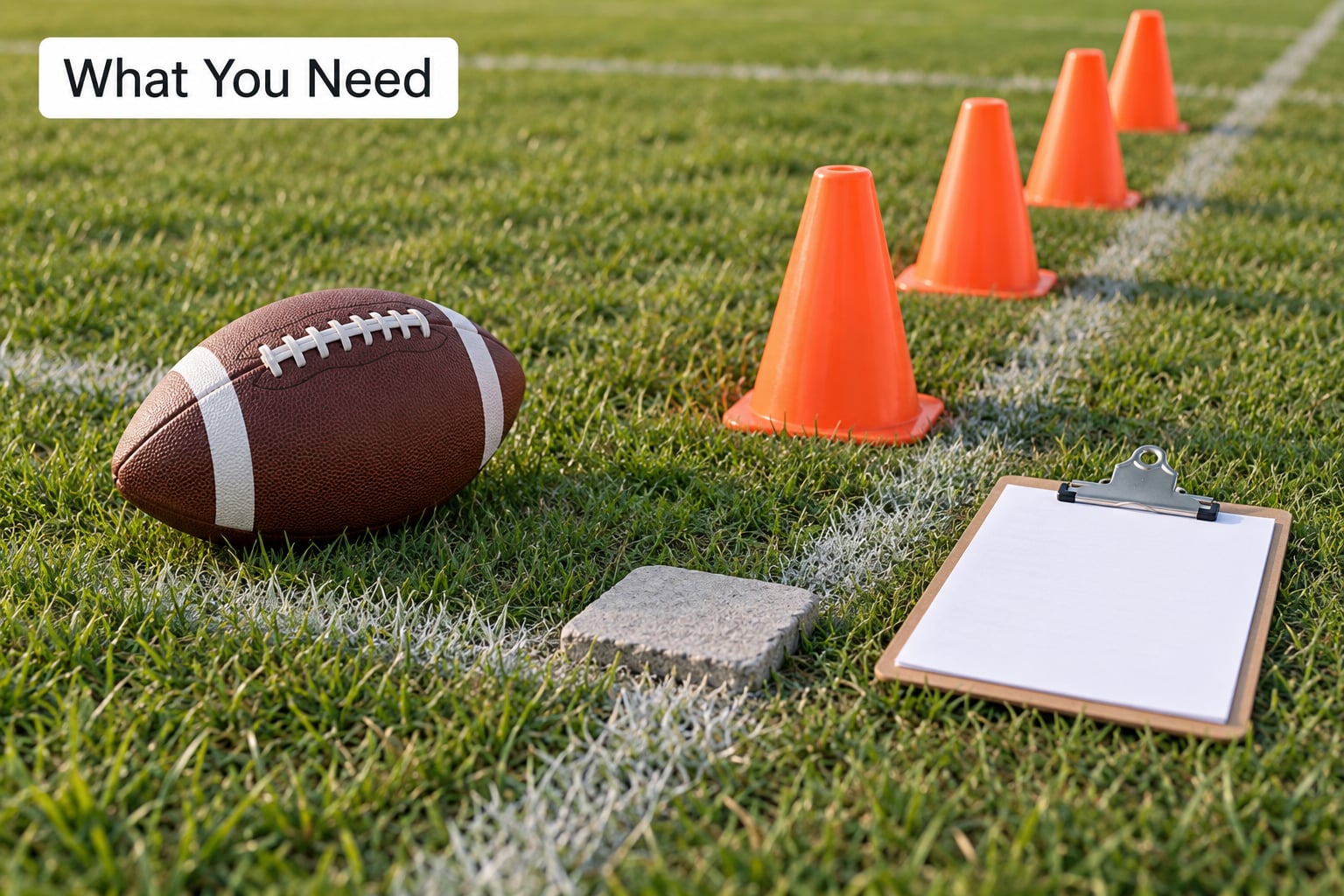
You need almost nothing. A ball, a strip of open ground and about ten minutes will carry you through most of a teaching session.
- A safe playing area. A driveway, a park lawn or the end of a quiet street works. Check the ground first; a ball that bounces off a fence teaches the wrong lesson.
- A football. A youth size is fine. It does not need to be new, and it does not need to be regulation.
- Cones or anything tall. Four orange cones, four shoes, or four water bottles mark a field if you do not have one.
- Markers for lines. Flat stones, painter’s tape, or even a broom handle laid down works for a line of scrimmage.
- A rule card. One index card with the three rules you are working on that week. Not a rulebook.
- Optional visual aids. A printed field diagram or a phone video of a short clip helps more than you would expect for the snap and the huddle.
Skip the playbook, the whiteboard and the drills that need a coach. The forum consensus among parents of young players is consistent on this one: short, frequent, low-pressure sessions beat long structured practice every time.
Step-by-Step
1. Choose an Age-Appropriate Football Format
Flag football is the safest starting point and the easiest to teach, because removing a flag replaces half the rulebook with a single idea: pull the flag, the play is over. Tackle football adds blocking, tackling and a real safety conversation. Modified youth formats cut the team size and the field length so kids get more touches.
The rule of thumb is simple. Start a five or six year old in flag, move to tackle when the league asks and the child wants it, and never use the format as a status symbol. A kid who is ready for tackle at seven is doing the same thing as one who is ready at ten: playing a game with friends.
| Format | What changes | Best for |
|---|---|---|
| Flag football | A flag replaces the tackle; no blocking at the line | First seasons, ages 5 to 8, backyard play |
| Modified tackle | Smaller field, fewer players per side, limited contact | Ages 8 to 11 learning real downs and position |
| Full tackle | Standard field, full roster, full blocking rules | Age 12 and up, or when the league requires it |
| Six-man football | One offensive and one defensive line, no tight ends or linebackers | Small-town leagues and school teams short on numbers |
2. Explain the Basic Objective
Say it in one sentence and make the child say it back: you are trying to carry or throw the ball into the other team’s end zone, and you stop them from doing the same. That is the whole game. Everything else is a rule about how you do it.
Test that it landed by asking a follow-up nobody can fake. If the other team scores, we go to the end zone and try to get the ball back. If your child answers that correctly, the objective is taught. If they say we have to get a first down, they have learned a rule before the reason for it, and that ordering will cause confusion for weeks.
3. Teach the Field Positions
Positions are what parents say they cannot explain. They can. Use the plain job description rather than the name, and introduce the name second.
| Position | What they actually do |
|---|---|
| Quarterback | Hands the ball to the snap, then decides whether to pass, hand off or keep it |
| Running back | Takes the handoff and runs with the ball |
| Wide receiver | Starts wide, runs a route, catches passes |
| Tight end | Lines up next to the offensive line, blocks and catches short passes |
| Offensive line | The five players who block so the runner or quarterback has time |
| Defensive line | The players who try to get past the blockers to reach the ball carrier |
| Linebacker | Sits behind the defensive line and hunts the ball carrier |
| Defensive back | Covers the receivers deep in the field |
Position is the one area where the community says the official rules are not the hard part. On a thread that ranks near the top of the search results for this exact query, parents agreed that the laws of the game were easy to read and positions were the part nobody had explained to them. That matches what we see, so spend more time here and less on penalties.
4. Show How a Play Begins
A play starts with the snap, which is the pass from the centre to the quarterback. Before the snap, the offense huddles and the defense gets set. Nobody may cross the line of scrimmage until that ball is snapped.
Show it once, then have the child do it. Put the ball on the ground, walk them through it as if you are calling it: here we are in the huddle, they break, we line up, I put the ball on the line, I snap it, my quarterback takes it and looks for an open receiver. A nine year old understands that whole sequence once they have performed it twice.
5. Explain Downs, Yards, and the Line of Scrimmage
This is the concept that trips up adults more than children. Say it like this: the line of scrimmage is an invisible line across the field where the ball is placed, and it moves like a bubble every time a play ends. The team with the ball gets four tries, called downs, to move the ball ten yards forward. Move it ten yards and you get a new four tries. Do not, and the other team takes over.
To teach downs, yards, and the line of scrimmage in a way that sticks, put two markers five yards apart and put a flat stone on the line. On each down the child moves the stone a hand’s width forward. When it passes the second marker, reset the stone to the line and hand them four more downs. Ten minutes of that teaches more than ten minutes of explaining.
Flag football often removes downs entirely, which is worth knowing before you teach them. Some youth leagues keep downs in flag with a modified distance, others take them out. Check what your league actually does, because a child who hears “first down” in practice and then plays a game without them will lose confidence fast.
6. Teach Passing, Running, and Catching
A pass is the quarterback throwing the ball to a teammate who catches it. If the receiver catches it and keeps hold of it, the pass is complete. If it hits the ground, or if a defender touches it first, the pass is incomplete and the play is over at that spot.
The word that matters is secure. A half-caught ball bouncing off a chest is not a catch. Teach that by making catching the ball with both hands the house rule at home, even though the rulebook does not require it.
A handoff is different from a pass: the quarterback places the ball into the running back’s arms directly, with no throw. That distinction is easy to lose and easy to test. Ask your child to show you a handoff and a pass, and if they describe both as throwing, repeat the difference with the ball in your hands.
7. Practice Scoring and Clock Rules
Carrying or throwing the ball into the end zone is a touchdown, worth six points. In most youth leagues the extra point or the two-point conversion is simplified, often one point for a kick or one point for running it in, so check your league handbook rather than assuming the high school numbers.
A safety, worth two points, happens when the defense carries the ball into its own end zone. It is rare in youth football and you can safely leave it for later. Field goals, punts and kickoffs are also later-stage rules; most young leagues punt rarely and punt-on-fourth-down rules vary.
The clock is the part kids feel most. The clock runs during play, stops when the ball is dead, and usually is shortened late in a game. Tell them that a stopped clock is normal and not a problem.
8. Review Fouls, Safety, and Sportsmanship
Common youth football penalties include holding, illegal blocking before the snap, and unnecessary contact. You do not need to teach the full penalty list. Teach the idea that rules protect players, and that a referee making a call is doing the job they were hired to do.
That last part is where parents report the most frustration. When a child disputes a call, the useful script is short and consistent: the ref saw it differently than we did, we cannot see what the ref sees, and we go again. Do not argue the call yourself in front of the child, because they are watching how you handle it more than they are watching the official.
Safety rules are non-negotiable. No head contact, no tackling above the shoulders, no playing after the whistle. Those three cover most safety instruction in youth programs and they are enough for a home session.
9. Turn the Rules Into Practice Games
Children learn a rule when it costs them something once. Make the boundary real by playing until a pass goes out of bounds. Make downs real by stopping the session on the fourth down. Make the end zone real by marking it with cones and watching their face when they cross it.
Then do the check that tells you it worked: ask the child to explain the rule back to you in their own words. If they say a first down is when you get ten yards or a new four tries, the rule is in. If they repeat your phrasing back word for word, they memorised it and did not understand it, so demonstrate it again.
Finish with a quiz rather than a lecture. Five questions take three minutes: how many downs do you get, what do you do after the tenth yard, what happens if the pass hits the ground, where is the end zone, and which player hands the ball off. Missed questions are your lesson plan for the next session.
Rules You Can Safely Skip Until They Are Older
Parents ask for this list more than any other, because it is permission to stop worrying. Field goal mechanics, punt coverage, kickoff returns, onside kicks, the penalty list, and the exact differences between flag and tackle enforcement can all wait. So can most of the formation terminology.
Tell your child that a rule is coming later rather than pretending it does not exist. It removes the feeling that they are missing something everybody else knows.
Teaching Soccer Rules Instead
If your child plays soccer, the same method works with a different rule set. The objective is still one sentence: put the ball in the net, stop them doing it. Then work through the touchline, offside, the ten-yard restart rule, the penalty area, and why hands are not allowed except by the goalkeeper inside their own box.
The two sports share almost no rules, which is why mixing them confuses children. Here is the honest comparison.
| Topic | American football | Soccer |
|---|---|---|
| Scoring | Touchdown for six points | A goal worth one point |
| Field size | 100 yards with end zones, plus sidelines | One pitch with goals at each end |
| Restart after out of play | Play stops; the line moves | Throw-in, goal kick or corner kick |
| Possession rule | Only the team with the ball may move it | Any player may use the ball |
| Hands | Used in passing and catching | Not allowed except for the goalkeeper in their own box |
| Substitutes | Specialist substitution by position, common at older ages | Unlimited substitution in most youth formats |
| Hanging about rule | Not applicable | Players cannot stand offside when the ball is played to them |
Common Mistakes
Explaining too many rules at once. Four rules in one session produces a child who has learned none of them. Fix: one rule per session until the child uses it unprompted, then add the next.
Using terminology without a picture. “Offside,” “huddle” and “down” mean nothing in the air. Fix: name the thing, then hand them the thing.
Skipping the demonstration. Talking at a child is not teaching. Fix: every explanation is followed by the child doing it twice.
Confusing scoring with winning. A first-year team may lose every game and still have had a good one. Fix: praise the specific rule they used, not the result.
Correcting the coach. If the club teaches something differently from what you taught at home, the club wins. Fix: check the coach’s phrasing and use it, so your child does not get two versions of the same rule.
Pushing past the child’s age. A six year old does not need to know what a nickel formation is. Fix: keep a short skip list and hand it back when they are ready.
Frequently Asked Questions
What are the rules for U8 football?
U8 football usually means eight players a side on a shortened field, with the same core rules as the full game: four downs, ten yards for a first down, and the line of scrimmage. Most leagues also modify contact, coaching and clock rules, and some simplify or remove the extra point. Read your league handbook, because the modifications differ by region and change between seasons.
What is the best age for a child to start playing football?
Most children are ready between five and seven, when they can follow a simple instruction and handle a ball safely. Flag football is the usual entry point because contact is limited and the rules are easier to explain. There is no benefit to starting younger, and a child who watches older siblings or the game on television often picks up the objective before ever holding a ball.
Can you give a beginner’s guide to American football?
Here is the short version. Two teams of eleven, one ball, and a field with an end zone at each end. The offense has four downs to move the ball ten yards forward from the line of scrimmage, either by running or throwing. Reaching the end zone scores a touchdown. The defense stops the run and passes, and gains possession by intercepting, by sacking the quarterback behind their own line, or when the offense fails on fourth down.
What is tackle football?
Tackle football is the full-contact version of American football, where the ball carrier is brought down by wrapping the arms and pulling them to the ground rather than by removing a flag. Contact above the shoulders and to the head is prohibited. It is normally introduced around age eight or later, depending on the league, and safety instruction on tackling technique is taught before players use it in games.
Should parents let their child play football?
Youth football is a reasonable choice for many children, particularly if they enjoy being watched, tagged, and part of a team. Worth weighing: the injury profile is higher than in sports like swimming or soccer, and single-sport year-round seasons can crowd out other interests. Look for a league with certified coaches, limited contact for younger age groups, and a policy on concussion and return to play.
What are some easy football questions for kids?
Five that get useful answers from most children: how many downs do you get before you have to give the ball up, how far do you need to move for a new set of downs, what is it called if the pass hits the ground, where is the end zone, and which player hands the ball to the running back. Keep it to five and let them win most of them, which keeps the quiz worth repeating.
Start With the Objective and One Play
If you do nothing else from this guide, do this. Tell your child the game is about getting the ball into the other team’s end zone, then walk them through one complete play from huddle to snap to the run. Let them run it twice. Then add one rule, the first down, and stop there until they can explain it back to you.
That is how to teach kids the rules of football in a way that holds. One rule, one game, ten minutes, and a child who wants to go back out and do it again. Your league’s own rule book for the 2026 season is worth one read before their first practice, so you are using the same words their coach does.