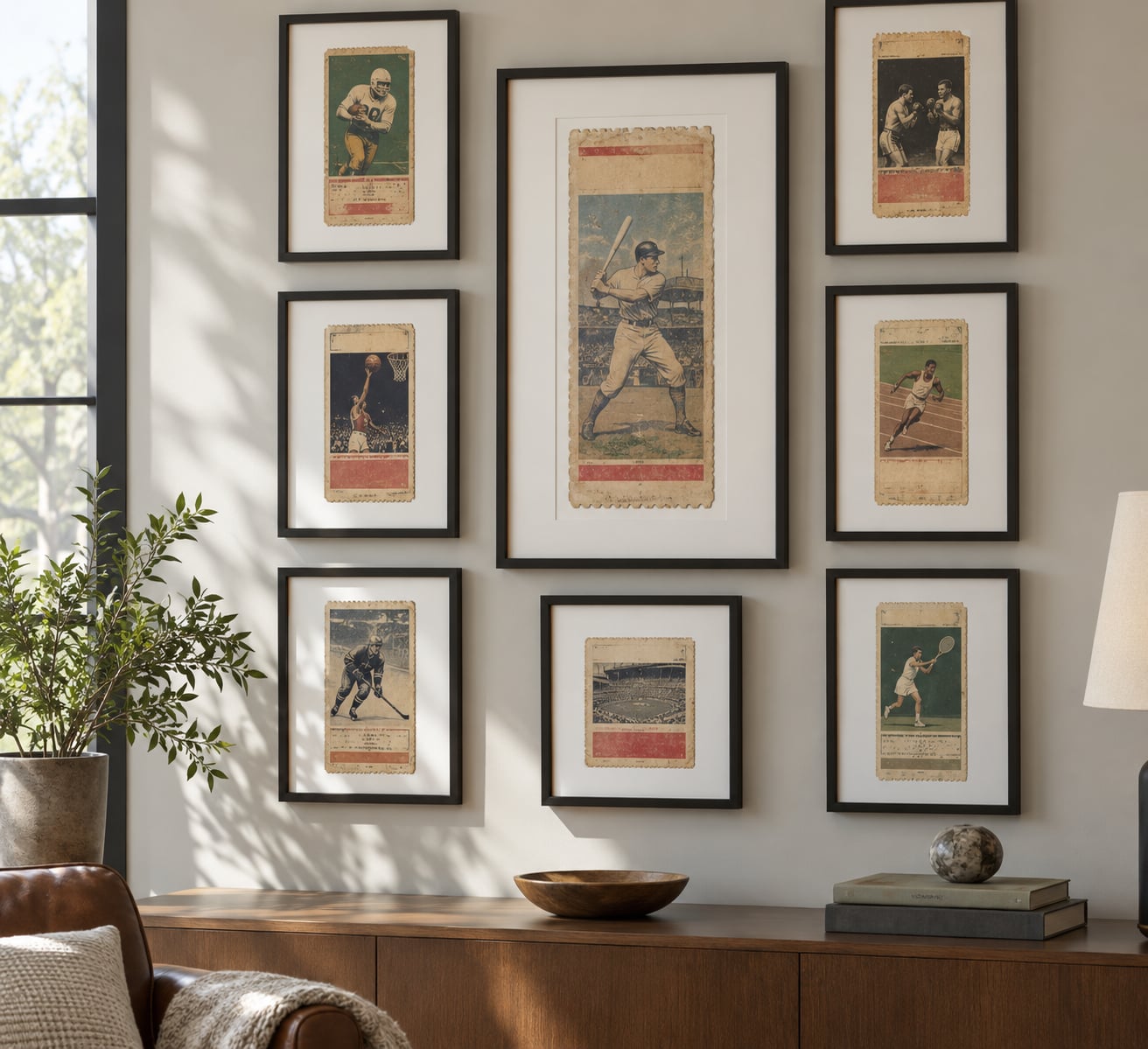
To frame a game ticket collection, first decide how many stubs you have, then pick the display format that fits: a single mat frame for one hero ticket, a multi-opening grid or collage frame for a wall of them, or a top-loading ticket shadow box if the collection is still growing. The whole job takes an afternoon once you have archival materials and a measured layout.
Most people get stuck at the same point, which is sizing. A standard game ticket stub runs about 7.25 by 4.25 inches, and once you know that number you can plan the grid on paper before you spend money on anything.
The other half of the job is keeping the ink alive. Printed ticket stock fades under light, and the printed face of a rivalry stub is the reason you kept it, so protection matters more than the frame profile. Below is the method I use, from sorting to hanging.
Table of Contents
- What You Need to Frame a Game Ticket Collection
- Step-by-Step: Framing a Game Ticket Collection
- How to Inspect and Sort the Tickets First
- How to Clean the Ticket Surface
- How to Arrange the Collection
- How to Measure and Cut the Mat
- How to Mount the Tickets Without Damage
- How to Add Glass or Acrylic and Seal the Frame
- How to Hang and Protect the Finished Display
- Framing a Collection That Is Still Growing
- Common Mistakes That Ruin a Ticket Display
- Frequently Asked Questions
- Can I frame old or fragile game tickets without damaging them?
- What is the best way to mount tickets inside a frame?
- Should I use glass or acrylic for a ticket collection?
- How do I prevent tickets and printing from fading?
- How should I arrange several tickets in one frame?
- Should valuable game tickets be professionally authenticated or graded?
- Conclusion
What You Need to Frame a Game Ticket Collection
You need a ticket stack sorted by date, a dry soft brush, acid-free mat board and a matching backing board, a frame with enough depth for the stack, a choice of glazing, and hanging hardware rated for the finished weight. Optional extras: a top-loading display case, archival corner mounts, and a fine-tip pen for labeling.
Archival materials are the one place not to economize. Acid-free mat board, a rag-free buffered backing and UV-filtering glazing cost very little compared to the ticket itself, and ordinary white mat board will brown and stain paper over a few years in a warm room.
Frame depth is the item people miss. Most standard frames are designed for a flat print. A stack of five or ten stubs is thick, and a frame with a shallow rabbet will force the back panel to bow and press the glazing onto the ink. Look for a frame sold as a shadow box, or ask for a mat board so thick that the stack sits well inside the frame.
One more thing worth having nearby: a soft clean cloth and a small brush for dust. Old stubs carry a surprising amount of pocket lint, and cleaning before mounting is far easier than cleaning behind glass.
Step-by-Step: Framing a Game Ticket Collection
How to Inspect and Sort the Tickets First
Sort the collection before anything else, and pull out anything brittle, torn, creased through a printed number, or faded beyond reading. Those stubs stay out of the frame or go in a separate archival album, because mounting a fragile stub is where most display damage happens.
Pick the front-facing examples. A stub with a clear seat location, date and opponent reads better than one where the print has gone gray, and a grid of twelve legible stubs looks like a collection rather than an accident.
Log each one as you sort: opponent, date, final score, section, row. Ten minutes of writing pays for itself when you are arranging the layout and again when someone asks what they are looking at.
How to Clean the Ticket Surface
Clean dry, always. Use a soft clean cloth or a very soft brush to lift dust, working in short strokes from the edge inward. Never use a damp cloth, water, cleaner or a solvent on printed ticket stock, since moisture lifts ink and leaves tide marks that do not come out.
Hold every stub by the edges with clean dry fingers. Skin oils are the fastest route to a darkened, brittle ticket, and handling 40 stubs the wrong way will show on the front of the frame.
Do not attempt to flatten a curled stub by pressing it under weight. That creases the paper permanently. Let it sit flat under another sheet of acid-free paper for a day or two instead.
How to Arrange the Collection
Arrange in a single sequence, either chronological by date, by team, or by rivalry, and pick one. A mixed order reads as clutter even when every ticket is worth keeping.
Leave a consistent gap around each stub. An eighth of an inch of even mat on all sides looks deliberate; uneven gaps look like someone crammed in whatever fit.
Give the grid a hero. One rivalry win, one postseason game, one bowl trip belongs in a larger opening or the center of the layout, with the ordinary home games supporting it.
How to Measure and Cut the Mat
Measure the actual frame opening, not the outside of the frame, and measure two tickets from opposite ends of the stack in case they vary. Most game stubs run close to 7.25 by 4.25 inches, which is the size fans search for when they ask what frame fits a ticket.
Cut the mat opening about a quarter inch wider and a quarter inch taller than the ticket. That gives each stub a small margin so nothing touches the cut edge and the ink has no place to wick against board.
Make the bottom border of the mat wider than the top, sides and bottom of the opening. That is the standard visual correction, because the eye reads a mat as tilted when the borders are equal.
Do the layout math on paper before cutting board. For a grid of nine openings across an 18 by 24 inch frame with a 2 inch mat border, each opening gets roughly 3 inches of space, which fits a stub rotated or shown at a slight angle. Larger collections need a bigger frame or a wall of frames, not tighter spacing.
How to Mount the Tickets Without Damage
Use archival corner mounts for most collections. They hold a stub by two or four small corners, never touch the printed face, and let you remove the ticket later without residue.
Use a double-sided float mount when you want the back of the ticket visible, which is where signatures and stub numbers live. The mount suspends the ticket in a sealed sandwich so neither side touches anything.
Skip ordinary tape, glue dots, paper clips and wet paste. Tape adhesive turns yellow and creeps into paper fibers, wet glue bleeds through thin ticket stock and puckers it, and anything metal leaves a permanent mark. Lamination pouches are popular in fan forums but they are not archival, they trap moisture, and they make the ticket impossible to remove or reorient later.
How to Add Glass or Acrylic and Seal the Frame
Use UV-filtering glass when the wall gets any direct or indirect daylight, and acrylic when the frame is large, heavy or in a game room where a dropped frame matters. Acrylic is lighter, shatter-resistant and blocks UV well, though it scratches more easily than glass and can look slightly hazy over time.
Leave clearance so the glazing never rests on the ink. That means a mat over the stub, and enough mat thickness or frame depth for the stack. Glazing pressed against printed stock is the most common cause of sticking and scuffing in a finished frame.
Clean the inside of the glass with a microfiber cloth and glass cleaner before you seat the backing, since a fingerprint baked in at that moment stays there for years. Seat the backing, secure the clips or turn buttons, and check the frame from an angle for any stub sitting proud of the mat.
How to Hang and Protect the Finished Display
Hang out of direct sun and away from heating vents, fireplaces and exterior walls that sweat in winter. Steady room humidity matters more than any single material choice, and a display that lives above a radiator will fade faster than one on an interior wall.
Match the hardware to the weight. A large grid frame full of stubs runs heavy, so use two points or a French cleat rather than a single nail and screw in drywall.
For a collection that is still growing, a top-loading ticket case beats a sealed frame. You can add a stub without reopening the display, and the case doubles as storage between seasons.
Framing a Collection That Is Still Growing
Frame a milestone set now and keep the rest in an archival album. A rivalry game, a conference title run or a senior season stub set will still mean the same thing in ten years, and a frame you sealed too early ends up holding four tickets with a lot of empty mat.
A second option is a top-loading case sized for more stubs than you currently have. Fans who want one display that absorbs new seasons tend to pick a case over a collage frame for exactly this reason.
Common Mistakes That Ruin a Ticket Display
Using ordinary tape or glue. Adhesive yellows, bleeds through thin stock and makes the ticket impossible to remove. Use archival corner mounts or a double-sided float mount instead.
Skipping UV protection. Any glass or acrylic can be specified with a UV filter, and it is the cheapest insurance you can buy against fading. This is the error fans notice five years later, when the score and section have gone pale.
Letting the glazing touch the ticket. No mat lip, or too little of it, means the glass rests on the ink and the stub sticks or scuffs. Add mat depth until there is visible clearance.
Using standard white mat board. It is not acid-free and it will brown over time, especially in a warm room. Ask for archival or museum-grade board and a rag-free buffered backing.
Buying a shallow frame for a thick stack. The backing bows and presses on the tickets. Measure the stack and buy depth, or use thick mat board to build the space.
Overcrowding the layout. Twelve stubs crammed into a frame reads as clutter. Fewer tickets with even borders looks like a collection somebody chose on purpose.
Wet-cleaning an old stub. Water and solvents lift ink and leave tide marks. Dry brush only, and skip cleaning entirely if the paper is already flaking.
Hanging in direct sunlight. A south-facing window wall will fade a display in a season. Move it to an interior wall or add a UV filter.
Frequently Asked Questions
Can I frame old or fragile game tickets without damaging them?
Yes, as long as you skip adhesives and pressure. Handle each stub by the edges, clean it dry with a soft cloth, and hold it with archival corner mounts or a double-sided float mount so nothing touches the printed face. Leave a mat lip between the ticket and the glazing. If a stub is already torn or flaking, keep it flat under acid-free paper in an archival album rather than forcing it into a frame.
What is the best way to mount tickets inside a frame?
Archival corner mounts for most collections, because they hold a ticket by two or four small corners and let you remove it later without residue. A double-sided float mount is the better choice when the back of the ticket matters, since it shows both the printed face and any signature or stub number. Avoid ordinary tape, glue dots, clips and wet paste, which yellow, bleed through thin ticket stock and pucker the paper.
Should I use glass or acrylic for a ticket collection?
Use UV-filtering glass in any room with daylight, since it blocks fading best and shows the print most clearly. Choose acrylic when the frame is large, heavy or in a game room with kids, because it is lighter and shatter-resistant. Acrylic scratches more easily, so clean it with a microfiber cloth only. Whichever you use, leave enough mat depth that the glazing never rests on the ink.
How do I prevent tickets and printing from fading?
UV-filtering glazing, no direct sunlight, and a wall away from radiators and heating vents do most of the work. Light exposure accumulates, so a display that hangs above a radiator fades faster than one on an interior wall. Keep steady room humidity and handle stubs by the edges, since skin oils darken paper over time. Expect any unprotected stub in a bright room to fade visibly within a season or two.
How should I arrange several tickets in one frame?
Choose one sequence and stay with it: chronological, by team, or by rivalry. Leave roughly an eighth of an inch of even mat on all sides of each stub, and make the bottom border of the mat wider than the top so the frame reads as square. Give the center or a larger opening to one hero ticket, such as the rivalry win, and let the routine home games support it.
Should valuable game tickets be professionally authenticated or graded?
For a signed or genuinely scarce ticket, a third-party grader or authenticator gives you a slabbed, tamper-evident holder that documents condition and verifies the signature, and that holder can itself be framed. For ordinary game and season stubs with no signature, there is little market, so spend your effort on archival protection instead. If you are unsure, ask a local memorabilia dealer what a specific ticket needs before paying for anything.
Conclusion
Start by sorting the collection and pulling out anything brittle or unreadable. Pick your format based on how many stubs survived that sort, measure the actual ticket at about 7.25 by 4.25 inches, and lay the grid out on paper before you cut board.
Then use archival materials throughout, give the grid one hero ticket and even spacing, and close it with UV-filtering glazing hung on an interior wall. That is most of the work, and it will hold up long after the next season’s stubs start stacking up.