To find vintage college sports memorabilia, start with what is already in your own closets and family keepsakes, then work outward to estate sales, thrift stores, alumni networks and booster club contacts, and finally to eBay sold listings, Etsy and specialist dealers for the rare pieces. Every purchase beyond a few dollars should pass a provenance check and a serial-number verification before money changes hands.
The reason the process matters is simple. Most college gear from the 1980s and 1990s was overproduced and carries almost no collector value, while modern throwback shirts are sold constantly as originals. Learning how to date a piece, read a listing, and compare recent sold prices is the difference between a collection worth keeping and a garage full of noise.
This guide covers the whole search, updated for 2026: where to look, how to date what you find, how to check a seller, how to price it honestly, and what to do once the piece is in your hands.
Table of Contents
- What You Need
- Step-by-Step
- Step 1: Define the Team, Era, and Items You Want
- Step 2: Learn How to Find Vintage College Sports Memorabilia Online
- Step 3: Build a Record of the Item You Are Looking For
- Step 4: Check the Seller, Listing, and Provenance
- Step 5: Inspect Condition and Authenticity in Detail
- Step 6: Compare the Price With Recent Sales
- Step 7: Buy Safely and Preserve the Item
- Common Mistakes
- Frequently Asked Questions
- Conclusion
What You Need
Four things make the difference between a weekend browse and an actual collection: a defined target, a research habit, a record-keeping system, and a spending ceiling you write down before you start.
A target means more than a school name. Decide the era and the item type first, because a 1960s felt pennant and a 1990s starter jacket are found in completely different places and cost wildly different amounts to verify.
Your research tools are unglamorous. A phone camera for close-ups of labels, stitching and wear, a tape measure, a magnifier or loupe, a notebook or spreadsheet, and saved searches on the marketplaces you use. Most dating clues live in about a two-inch square of fabric near the hem or neck.
Set a budget per item and a total. Beginners regularly overpay on a hoodie because a listing called it rare, and a per-item ceiling stops you from convincing yourself that a faded, pilled sweatshirt is a grail.
Step-by-Step
Seven steps take you from a vague interest to a documented, correctly priced piece. Work them in order and the expensive mistakes happen later, not earlier.
Step 1: Define the Team, Era, and Items You Want
Narrow your search to one school, one sport, one season range, or one object type. Collectors who spread a small budget across ten teams end up with ten mediocre pieces instead of one shelf that reads as a set.
Pick a window and stick to it. A self-imposed cutoff of pre-1980 keeps you away from the overproduction glut, and a cutoff of pre-1960 puts you in felt, chain-link warm-ups and hand-stitched lettering.
List the specific items you want, such as letterman jackets, crewneck sweatshirts, cheerleader uniforms, yearbooks, media guides, program books, seat cushions, class rings, pennants or game-used equipment. A list keeps impulse buys in check.
Step 2: Learn How to Find Vintage College Sports Memorabilia Online
The fastest online channels are auction platforms and marketplace sold listings, specialist dealers, collector communities, card and memorabilia shows, and team archives. Each one rewards a different search term.
Start with the terms collectors actually use: team name plus era words like single-year, plus an object type. Search lot, collection and box listings too, because sellers frequently do not know what is sitting inside a cardboard carton.
Offline channels outperform most people expect. Estate sales, thrift stores, antique malls, flea markets and garage sales in towns with a major program produce genuine surprises, and alumni groups, booster club boards and athletic department surplus sales are the highest-hit-rate sources for team-specific pieces that never reach a marketplace.
Your local college bookstore and equipment room can also be worth a call. Old stock occasionally surfaces during a remodel, and a friendly archivist at the athletic department will sometimes know where retired gear went.
Step 3: Build a Record of the Item You Are Looking For
Know what the item should look like before you pay for it. Research uniform designs by decade, player careers, event dates and manufacturer marks so you can tell an original from a modern copy in ten seconds.
Print runs matter more than most sellers admit. When a company made forty thousand of a design, age alone does not make it collectible, and knowing the production scale protects you from paying a rarity premium for a mass-produced sweatshirt.
Save reference photographs of the same item in good condition. When a listing photo looks dark and you are deciding between faded and dirty, a side-by-side comparison tells you which one it is.
Step 4: Check the Seller, Listing, and Provenance
A trustworthy seller shows detailed photographs, names the era and manufacturer, states flaws openly, offers returns, and has a long feedback history. Vague listings with one blurry photo and no measurements are where problems live.
Ask one question before you bid: where did this come from? An honest answer is a family estate, a storage unit, a booster club purchase or a long-term collection. Vague provenance is not proof of anything.
Red flags are easy to spot once you know them. A certificate of authenticity with no serial number, a seller who cannot produce a working number, an item priced far below the player’s known official memorabilia rate, a sudden deep discount on a high-demand piece, or an item described as unreproduced when the mass-market tag tells a different story.
Step 5: Inspect Condition and Authenticity in Detail
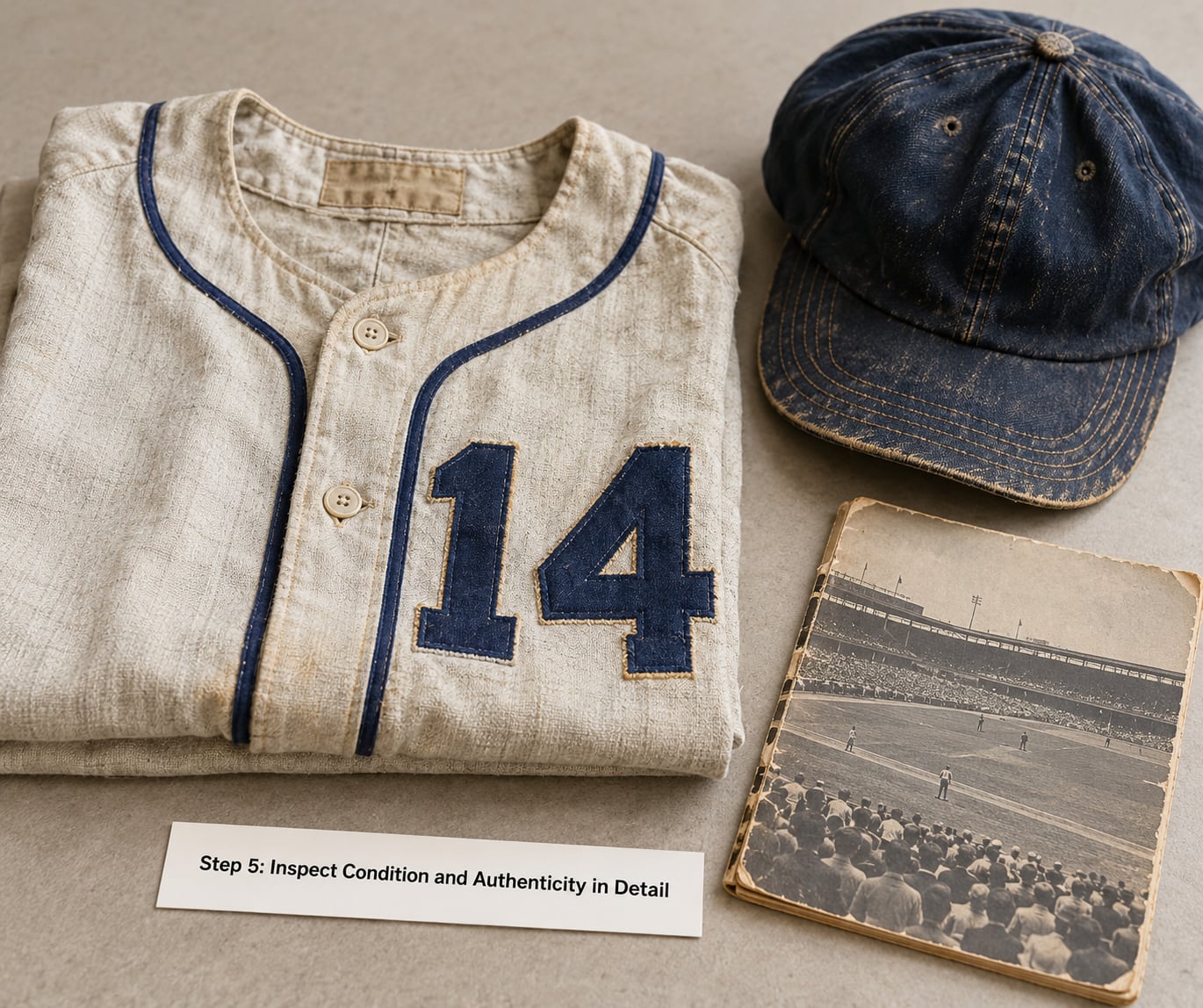
Authenticity lives in construction details. Check the material weight and drape, look at stitch density and thread type at the seams, and compare the printing technique, since original screen printing sits differently on fabric than modern digital transfers and heat-applied lettering.
Condition grading matters as much as authenticity. Fading, pilling, tears, repairs, odors from storage and amateur relabeling all cut value, and bleach spots or re-stitching are a reason to walk away rather than bargain.
Paper pieces get their own checklist. Original tags, care tags and union labels date a garment, while program books and yearbooks should show age-consistent yellowing, a period-correct cover stock and no modern barcode on the back.
For anything signed, verify the certificate of authenticity rather than trusting it. Collectors on r/SportsMemorabilia and r/Autographs repeat the same point: a certificate proves nothing on its own because the certificate itself can be cloned, so the serial number must be independently checkable in the issuer’s own database. PSA/DNA, Beckett Authentication Services and JSA are the names collectors reach for.
Step 6: Compare the Price With Recent Sales
Use sold and completed listings, not asking prices. An asking price is a wish, and a listing that has been relisted three times is usually priced above what the item will actually bring.
Adjust the comp for rarity, condition, provenance, player fame, era desirability and current demand. The same design in mint condition with original tags is a different market from the same design faded and monogrammed.
Run the comparison the other way too. If you cannot find three genuine sold examples in the same condition, you are probably looking at a rare piece, and rare deserves a conversation rather than an impulse.
Step 7: Buy Safely and Preserve the Item
Pay through a protected method with a documented return window, keep screenshots of the listing and every photo, and save the invoice and provenance notes in the same folder as the item’s record.
Spell out your expectations in writing: whether tracked or insured shipping is required, how quickly it must go out, and what happens if the piece arrives with a problem. When the seller answers in writing, disputes tend to resolve themselves.
Store textiles folded rather than on a hanger, away from direct light and heat, with acid-free tissue between layers. Paper goes in archival folders at stable room humidity. If you frame a jacket or a program, use an acrylic or glass front rather than anything containing PVC, and keep it off a wall that gets sun.
Common Mistakes
Most beginner losses come from a handful of repeat errors, and each one has a straightforward fix.
Trusting a rarity claim. A seller saying rare means nothing on its own. Fix: ask for the production run or find a second sold example with the same marker before you treat rarity as established.
Confusing a reproduction with an original. Modern throwback shirts deliberately copy old designs. Fix: check the care tag, the neck label and the stitching, and remember that no true vintage piece carries a modern care tag.
Ignoring provenance. A team-issued or game-issued piece with documented history is worth more than a shelf copy with the same design. Fix: keep every scrap of documentation you receive and add it to the item’s record.
Comparing asking prices with sold prices. Fix: work only from completed sales in matching condition, and note the date, since the collector market moves.
Cleaning a piece before appraising it. Washing or pressing can permanently damage value and hides the evidence you were trying to read. Fix: never clean before an appraisal, and treat heavy fading and pilling as part of the grade.
Overpaying for signed items. Signatures on mass-produced merchandise carry little weight. Fix: check the athlete’s official memorabilia contract rate, and treat anything dramatically below that as suspect rather than as a bargain.
Frequently Asked Questions
How do I know if vintage college sports memorabilia is authentic?
Check four things in order: the era markers on tags and stitching, whether a certificate of authenticity carries a working serial number, whether that number matches the item in the issuer’s public database, and whether the seller offers a return policy. A certificate alone proves nothing, because certificates get cloned. Build a record for every piece as you buy it.
What is the best way to value a vintage college jersey?
Compare recent sold listings rather than asking prices, and match condition as closely as you can. Then adjust for rarity, whether the piece is team-issued or retail licensed, provenance, player fame and how many of that design were produced. Keep the comps in a spreadsheet with dates, since prices shift. Three or more genuine sales in similar condition make a fair comparison.
Should I buy college sports memorabilia from an auction site?
Yes, with protections in place. Search completed listings on the same site first to learn the real market, then check the seller’s feedback count and history, the item’s photos and description, and the return window before you bid. Pay through the platform’s protected method rather than off-platform transfer. Walk away if a seller pressures you to move money another way.
How should I store vintage jerseys, caps, and programs?
Fold textiles rather than hanging them, keep them out of direct light and away from heat, and separate layers with acid-free tissue. Store paper items in archival folders at stable room humidity, laid flat. For framed pieces, use an acrylic or glass front instead of PVC and choose a wall without direct sun. Good habits cost nothing and prevent most future damage.
Are signed college sports memorabilia pieces worth more?
Usually yes, but only when the signature is verified and the athlete actually had a memorabilia contract. Check the certificate’s serial number in the issuer’s own database rather than trusting the seller’s copy. Signatures on mass-produced merchandise add little. If a price sits far below the athlete’s official contract rate, treat that as a warning rather than a deal.
Conclusion
Pick one team and one era before you spend anything, write down three examples of the item you want with their recent sold prices, and start with your own closets and your school’s alumni network. Those two places will produce more than most beginners expect.
From there, slow down on the pieces that matter. Check the tags, check the provenance, verify any certificate serial number yourself, and buy through a protected method. Learning how to find vintage college sports memorabilia is mostly learning what to ignore.